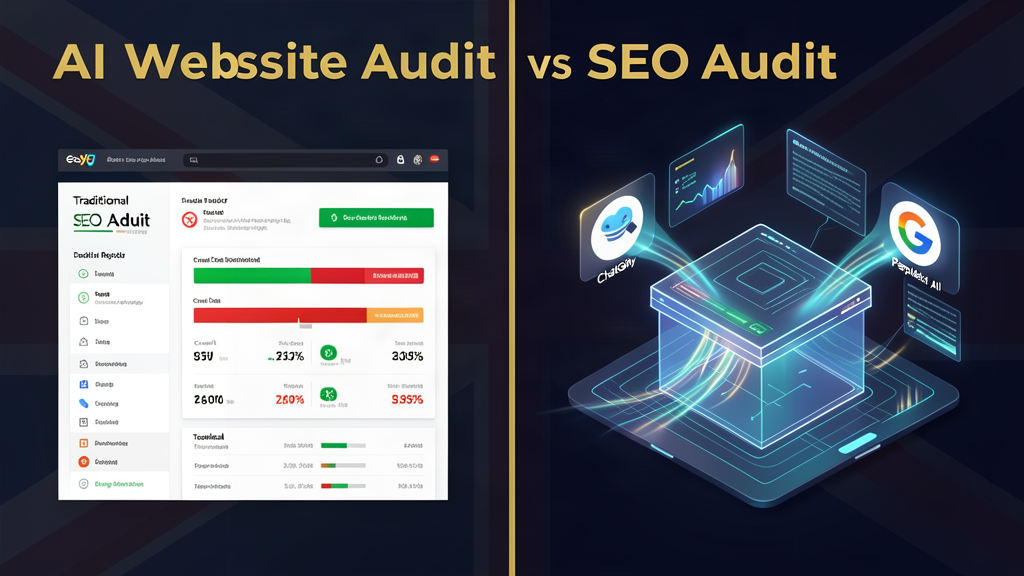
An SEO audit checks whether Google can find and rank your site. An AI website audit checks that too, plus whether AI engines like ChatGPT and Perplexity can crawl, understand, and cite your content — and whether human visitors actually trust and convert. For most UK small businesses in 2026, you need both, and a combined audit costs £400 to £3,000 depending on site size.
What Is an SEO Audit and What Does It Check?
An SEO audit is a systematic review of your website's ability to rank in search engines. It covers four main areas that determine whether Google shows your site to potential customers.
Technical SEO checks whether search engines can crawl and index your site. This includes page speed, mobile usability, broken links, redirect chains, XML sitemaps, and robots.txt configuration. If Google cannot access your pages, nothing else matters.
On-page SEO reviews the content and structure of individual pages. Meta titles, heading hierarchies, keyword usage, internal linking, image alt text, and content quality. These signals tell Google what each page is about and who should see it.
Off-page SEO examines your backlink profile and domain authority. How many other websites link to yours, the quality of those links, and how your authority compares to competitors ranking for the same keywords.
Competitor analysis benchmarks your site against those already ranking. What keywords they target, what content they publish, where their backlinks come from, and where the gaps are that you can exploit.
What Is an AI Website Audit? (The 2026 Upgrade)
An AI website audit goes beyond traditional SEO. It checks whether the new generation of AI-powered search engines can find, read, and cite your content in their answers.
AI crawler access is the first check. GPTBot (used by ChatGPT), ClaudeBot (Claude), PerplexityBot, and Google's own AI crawlers all need to access your site. Many websites silently block these bots through CDN rules or firewall settings, even when robots.txt allows them. This is the single most common finding in AI audits — roughly 40 percent of sites have this problem.
Structured data and schema validation checks whether your site provides the machine-readable context that AI engines need. Schema markup tells AI what your business does, where you operate, what you sell, and how to contact you. Without it, AI engines guess — and often guess wrong.
Entity clarity and semantic structure tests whether AI engines can identify your business as a distinct entity. This means consistent NAP (name, address, phone) data, clear service descriptions, and content structured around topics rather than keywords.
The llms.txt file is a new standard that tells AI crawlers which content to index and how to attribute it. Sites without this file leave AI engines to make their own decisions about what to crawl.
GEO (Generative Engine Optimisation) readiness measures how likely your content is to appear in AI-generated answers. This includes answer formatting, citation-worthy statistics, and authoritative sourcing.
SEO Audit vs AI Website Audit: Side-by-Side Comparison
| Factor | SEO Audit | AI Website Audit |
|---|---|---|
| Primary focus | Google search rankings | AI engine visibility + Google rankings |
| Crawlers tested | Googlebot, Bingbot | GPTBot, ClaudeBot, PerplexityBot + traditional crawlers |
| Schema checks | Basic structured data | Deep schema validation, entity clarity, llms.txt |
| Content analysis | Keyword optimisation, readability | Citation worthiness, answer formatting, authority signals |
| Output | Prioritised fix list (PDF/spreadsheet) | AI visibility score + GEO recommendations |
| Typical cost (UK SME) | £400-£3,000 | £500-£3,500 (combined scope) |
| Timeline | 1-4 weeks | 3-7 days |
| Who needs it first | Not ranking on Google at all | Getting traffic but no conversions |
How Much Does an SEO Audit Cost in the UK? (2026 Pricing)
Audit pricing varies wildly. Understanding what you get at each price point prevents both overspending and underbuying.
| Audit Type | UK Price Range | What You Get |
|---|---|---|
| Free tool scan | £0 | Automated crawl, basic issue flags, no prioritisation |
| Basic manual audit | £300-£800 | Single-scope (technical or content), small site, PDF report |
| Comprehensive SME audit | £1,500-£3,000 | Technical + content + backlinks + competitor analysis + action plan |
| E-commerce / larger sites | £3,000-£8,000 | Full scope including product page optimisation, faceted navigation, international SEO |
| Enterprise | £8,000-£20,000+ | Multi-domain, multi-market, technical architecture review, migration planning |
Senior UK SEO specialists charge £80 to £175 per hour. Below £300, you are typically getting automated software output with no human interpretation. Above £3,000 is usually enterprise scale. The sweet spot for most small businesses is £1,500 to £3,000 for a comprehensive audit that covers technical health, content, backlinks, and a prioritised action plan.
Free SEO Audit Tools: Are They Good Enough?
Several free tools can surface basic technical issues. Understanding what they catch — and what they miss — saves you from either overpaying or having a false sense of security.
Google Search Console is the most authoritative free tool. It shows exactly what Google sees: crawl errors, indexation status, mobile usability issues, and Core Web Vitals scores. Every website owner should have this set up. It is free and the data comes directly from Google.
Screaming Frog (free tier) crawls up to 500 URLs and reports broken links, missing meta tags, redirect chains, and duplicate content. Excellent for technical triage on small sites.
Ahrefs Webmaster Tools provides a free site audit covering health scores, error counts, and backlink data. Limited compared to the paid version but useful for basic monitoring.
Google PageSpeed Insights tests Core Web Vitals: loading speed, interactivity, and visual stability. These scores directly affect Google rankings.
The limitation: free tools surface issues but do not prioritise them. A site with 200 flagged issues needs someone to tell you which 10 matter most. Free tools also cannot assess content quality, backlink health, or competitive positioning. They catch 30 to 40 percent of real issues — the technical ones. The remaining 60 percent requires human expertise.
Best AI Website Audit Tools for UK Businesses (2026)
The AI audit tool landscape is evolving fast. Here are the tools worth considering in 2026.
Cruelx offers full AI diagnosis across SEO, design, trust, and conversions. A one-time £8.99 scan covers AI visibility, technical health, and conversion friction. Best value for a broad first look.
AuditZap specialises in AI visibility scoring. It distinguishes between AI-ready auditors and AI-answer monitors, testing whether your content appears in ChatGPT and Perplexity responses. Free tier available.
PageLens AI focuses on launch readiness. Founder-oriented with practical tool stack recommendations. Good for new sites preparing to invest in ads.
Semrush Site Audit is the broadest platform option. From $139.95 per month, it covers technical SEO, content, backlinks, and competitive analysis. Strong if you need ongoing monitoring, not just a one-off scan.
Screaming Frog remains the deepest technical crawler. £199 per year for unlimited URLs. Not AI-specific, but essential for technical SEO depth that AI-only tools miss.
What Does an AI Website Audit Actually Find?
The most common AI audit finding surprises most business owners: CDN or firewall rules that silently block AI crawlers like GPTBot, even when robots.txt allows them. Your hosting provider's security settings may be preventing ChatGPT from reading your content without you knowing.
Other frequent findings include:
- Missing structured data. No schema markup means AI engines cannot identify your business type, location, services, or reviews. They see text without context.
- No llms.txt file. This emerging standard tells AI crawlers how to handle your content. Sites without it leave the decision to the crawler.
- Weak entity signals. Inconsistent business name, address, and phone number across your site and external listings. AI engines cannot confirm you are a real, trustworthy business.
- Content invisible to AI answer engines. Pages structured for Google's ranking algorithm but unreadable by AI engines that generate conversational answers.
- Design trust and conversion friction. Pages that technically load but fail to build trust — missing trust signals, unclear calls to action, poor mobile experience.
Which Audit Do You Need First? (Decision Framework)
Use your current symptoms to decide which audit delivers the most immediate value.
"I don't show up on Google at all" — Start with an SEO audit. If Google cannot find your site, AI engines cannot either. Fix crawlability and indexation first.
"I get traffic but nobody enquires" — Start with an AI website audit. The page is findable but not persuasive. This is a conversion and trust problem, not a ranking problem.
"I just launched, about to spend on ads" — Start with an AI website audit. Confirm the site is technically sound and trustworthy before paying to send traffic to it.
"I have steady sales and want to grow" — Both audits, SEO first. Build the ranking foundation, then optimise for AI visibility and conversion.
A quick diagnostic: check Google Search Console. If you have impressions without clicks, it is a search problem (SEO audit). If you have clicks without conversions, it is a page problem (AI website audit).
How Daedalus Design Does Website Audits Differently
Most agencies sell audits as standalone products. You pay £1,000 to £3,000, get a PDF report, and then figure out what to do with it. Daedalus takes a different approach.
We include an AI-powered website audit with every build. Not as an upsell. Not as a separate engagement. It is part of how we work. Before we write a single line of code, we audit your existing site (if you have one) across four pillars:
- SEO health. Technical crawlability, Core Web Vitals, meta tag quality, internal linking structure.
- AI visibility. GPTBot/PerplexityBot access, schema markup, entity signals, llms.txt configuration.
- Accessibility. WCAG 2.2 AA compliance, EAA readiness, screen reader compatibility, keyboard navigation.
- Conversion psychology. Trust signals, call-to-action placement, mobile experience, page flow.
You get prioritised fixes, not just a score. We tell you what to fix first, what to fix second, and what can wait. And because we are building your site, the fixes happen during the build — not in a separate project you have to manage.
This is UK-specific: EAA compliance for businesses serving EU customers, .co.uk geotargeting, UK hosting performance, and pound-sterling pricing throughout.
What to Do After Your Website Audit
An audit without action is a waste of money. Here is the sequence that works.
Week one: fix technical issues. Crawlability problems, broken links, redirect chains, page speed, schema markup. These block everything else. You cannot rank content on a site Google cannot crawl.
Weeks two to three: content and on-page. Rewrite thin pages, improve heading structures, add internal links, optimise meta tags, create missing service pages. This is where most of the ranking improvement happens.
Week four onwards: off-page and monitoring. Backlink building, local citation consistency, Google Business Profile optimisation, ongoing Core Web Vitals monitoring.
Most SME audits produce 30 to 80 prioritised fixes. Tackle the high-impact, low-effort ones in week one. The remaining items form a 90-day improvement plan.
Frequently Asked Questions
How long does a website audit take?
A basic automated audit runs in minutes. A proper manual SEO audit takes 1-4 weeks depending on site size. An AI website audit with human review typically takes 3-7 days for an SME site.
Can I do a website audit myself?
Yes, using free tools like Google Search Console and Screaming Frog. You will catch basic technical issues. But interpreting findings, prioritising fixes, and assessing competitive gaps requires SEO expertise most business owners do not have.
How often should I audit my website?
Run a full audit annually, a technical health check quarterly, and monitor Core Web Vitals monthly. Audit again after any major site change, migration, or Google algorithm update.
What is the difference between a website audit and an SEO audit?
They overlap significantly. An SEO audit focuses specifically on search ranking factors. A broader website audit may also cover accessibility, security, conversion UX, and brand trust signals.
Are AI website audits accurate?
AI audit tools are accurate for the signals they measure (technical SEO, schema, speed). They are less reliable for subjective assessments like design quality or copy effectiveness. Use them as a starting point, not a final verdict.
Do I need an audit before redesigning my website?
Absolutely. An audit before a redesign tells you what is working (preserve it), what is broken (fix it), and what is missing (add it). Skipping this step is the most common reason redesigns lose traffic.
Get Your Free AI Website Audit
Every Daedalus Design build includes a comprehensive AI-powered audit covering SEO, AI visibility, accessibility, and conversion. Our website packages start from £299.
Book Your Audit View Packages