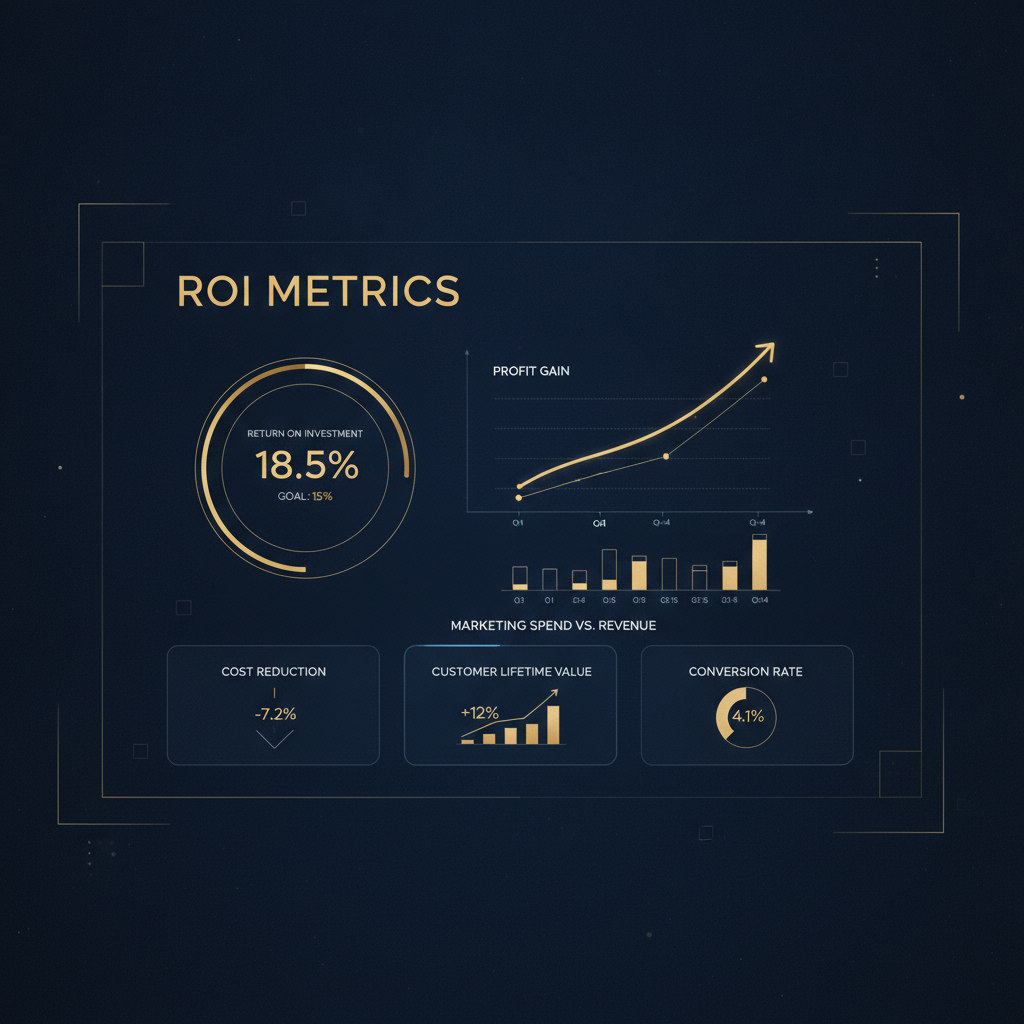
Here is a number that should bother you: 89% of small businesses now use AI in some form, according to the 2026 U.S. Chamber of Commerce survey. But when researchers at MIT looked at whether those tools actually moved the needle on revenue or costs, they found that 95% of generative AI pilots showed zero measurable impact on the profit and loss statement.
That is not a typo. Nearly everyone is using it. Almost nobody can prove it is working.
The problem is not that AI does not work. It is that most business owners adopted it fast and never built a way to measure whether the money and time they spend on it comes back. If you are paying for AI tools and cannot answer the question "is this paying for itself?", you are guessing. And guessing is expensive.
Why Measurement Matters More Than Adoption
The gap between "using AI" and "getting value from AI" is the defining business tech story of 2026. BCG's 2026 AI Radar survey found that only 5% of enterprises report substantial ROI from AI at scale. KPMG's Global AI Pulse, surveying 2,110 C-suite leaders across 20 countries, put the number at 8%. Even IBM's more generous CEO study found that 56% of chief executives admitted to zero significant financial benefit from their AI investments.
Small businesses are in a different position, though. You do not have $186 million budgets to burn through. You have a monthly software bill and a finite number of hours in the week. That makes measurement easier, not harder. You just need to track the right things.
The honest truth: Most businesses that adopted AI did so because it felt like something they should do, not because they had a clear plan for what it should achieve. That is fine as a starting point. But after six months, you need receipts.
Number 1: Hours Saved Per Week
This is the easiest metric to track and the one most business owners care about first. Business.com's 2026 research found that the average small business worker saves 5.6 hours per week using AI tools. Owners and managers save over 7 hours.
Seven hours a week is not abstract. That is an entire working day. If your hourly rate is £50, that is £350 per week, or roughly £18,000 per year, in recovered time. And that is just the direct time saving. It does not account for what you do with that time instead.
How to track it: For two weeks, keep a simple log. Every time you use an AI tool for a task you used to do manually, note the task and estimate how long it would have taken without the tool. At the end of two weeks, you will have a real number.
Number 2: Cost Per Task Compared to Before
This is where the maths gets interesting. The cost difference between a human handling a routine task and an AI handling it is not subtle.
A human customer service agent costs roughly £15 to £20 per interaction when you factor in salary, training, and overhead. An AI agent handling the same query costs between 40p and 55p. That is a 30 to 40 times difference per conversation, according to data compiled across multiple 2026 industry analyses.
The same pattern holds across other tasks. Content creation that would cost £200 to £500 from a freelancer or agency can be produced with AI tools costing £30 to £40 per month in total subscriptions. McKinsey's 2026 research puts the average ROI on AI tool investment for small businesses at 3.7 times the spend.
How to track it: Pick three tasks you use AI for regularly. Write down what those tasks cost you before (in money or time) and what they cost now. The difference is your per-task saving.
Number 3: Revenue Change Since Adoption
Salesforce's 2025 SMB Study found that 91% of small businesses using AI report measurable revenue increases. The U.S. Chamber of Commerce found that AI-using businesses are 2.3 times more likely to report revenue growth than those that are not using it.
These are self-reported numbers, so take them with some caution. But the direction is consistent across every survey: businesses that use AI well tend to make more money. The question is whether "using AI" is the cause, or whether businesses that are already growth-minded simply adopt new tools faster. Probably a bit of both.
How to track it: Compare your revenue for the six months before you started using AI tools against the six months after. Control for seasonal patterns if you can. If revenue has grown and the only major change was adopting AI, that is a reasonable signal.
Number 4: Customer Response Time
AI chatbots and automated response systems do not sleep. They answer enquiries at 2am, on bank holidays, and during your lunch break. For service businesses, response time is directly linked to conversion. A lead that waits four hours for a reply is far less likely to become a customer than one that gets a helpful response in two minutes.
The 2026 Zendesk customer service report found that 51% of consumers now prefer bots for immediate service, and 48% cannot tell the difference between an AI response and a human one. The quality bar has risen to the point where AI is not a compromise. For routine questions, it is often faster and more consistent.
How to track it: Log your average first-response time for the past month. If you have AI handling initial enquiries, compare it to your previous average. Most chat tools and CRM platforms track this automatically.
Number 5: The Stuff You Stopped Paying For
This is the metric people forget. AI does not just save time on things you still do. It replaces things you used to outsource.
Most small businesses report reducing marketing contractor costs by 50 to 70% after integrating AI into their content workflows, according to 2026 industry data. The combined cost of Claude Pro and ChatGPT Plus, which form the core small business AI toolkit, is about £30 per month. That replaces £400 to £2,500 per month in agency or freelancer spend for many businesses.
How to track it: List every external service or contractor you were paying for 12 months ago. Cross off the ones you have replaced or reduced since adopting AI. Add up the difference. That number is often the most surprising one.
A word of caution: AI replaces tasks, not judgment. The businesses that report the highest ROI are the ones that use AI to handle the repetitive work while keeping a human involved in the decisions that matter. Automating a bad process just produces bad results faster.
Putting It Together
You do not need a spreadsheet with fifty columns. You need these five numbers, checked once a quarter:
Hours saved per week. Cost per task before and after. Revenue change since adoption. Average customer response time. External costs you have cut.
If those numbers are moving in the right direction, your AI spend is justified. If they are flat or going the wrong way, you are probably using the wrong tools, using them for the wrong tasks, or not using them well enough. That is not a reason to abandon AI. It is a reason to change your approach.
The 5% of businesses getting real ROI from AI are not doing anything magical. They picked specific problems, measured the outcomes, and adjusted when the numbers told them to. That is it. The technology is the easy part. The measurement is where most people fall off.
Not sure where your AI spend is going?
We help UK businesses build websites and systems where every tool earns its place. No black boxes, no vanity features, just things that work and can be measured.
Get a Free Audit