AI answers now sit at the top of Google. Ask it a question and one written answer appears above the ordinary links, stitched together from several websites and naming them as sources. If your business is one of those sources, a fair question follows: does any of that send real visitors to your site, or does Google keep the click?
Until late October 2026 nobody outside Google had a number worth trusting. Google publishes none, and the report it hands website owners shows impressions only. Then an SEO consultant did something close to reckless with one of his own websites. He pulled it out of Google's AI answers and counted what changed.
The first look behind the numbers
On 30 October 2026, Cyrus Shepard published what he called a small case study. He used Google's opt-out control, the switch UK regulators pushed Google to add in June 2026 and which we covered in our guide to opting out of AI Overviews. With his site out of AI Overviews and AI Mode, he compared the days inside the answers with the days outside.
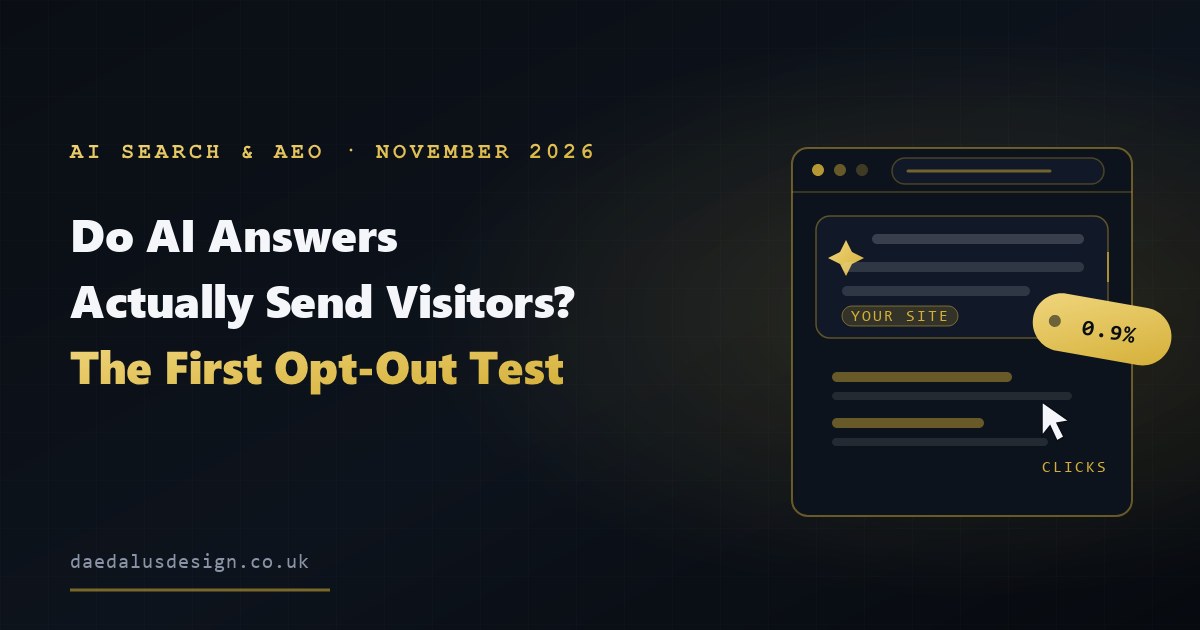
AI impressions dropped to zero the moment he threw the switch. While the site had been in the answers, those AI impressions made up about 8% of everything Google showed it. Working backwards from the site's overall click data before and after, he estimated the click-through rate on those AI impressions at roughly 0.9%.
The surprise came after that. With the site out of the answers, clicks on the plain links underneath fell too. The AI clicks were expected to vanish. Nobody had predicted the fall in the regular ones. His reading is that being quoted at the top of a results page lends a site enough credibility to earn more clicks everywhere below it. He calls it a search halo effect.
What one case study cannot tell you
Hold those numbers loosely. Shepard says so himself. It is one site, and he has not published its traffic size, the dates of the test, or how the opt-out was applied. The 0.9% is an estimate derived from overall totals rather than a direct count of clicks on the answer. And the AI answers themselves stayed on those searches throughout. His site left the answers. The answers did not leave the page.
Numbers like this travel fast and arrive distorted. Within days, 0.9% was being quoted as the click-through rate of AI Overviews, which it is not. It is one website's best estimate of its own figure, and it is a signal worth taking seriously, but not a benchmark for anyone else.
What a bigger experiment found
The wider question has sturdier evidence behind it. A team of US researchers published a preprint on 18 August 2026 describing a randomised trial with 1,100 people who use Google as their main search engine. Through a browser extension, everyone browsed normally for three days, then spent a week in one of three conditions: ordinary Google, Google with the AI answers hidden, or Google with every search pushed into AI Mode.
Hiding the AI answers raised how often people clicked through to websites by about 8.8 percentage points. Pushing everyone into AI Mode cut click-through by about 18.8 points, and the people in that group spent longer inside Google per session while venturing onto the wider web less often. When the answer sits on the page, fewer people leave it.
The limits are worth naming. The participants were American, skewed young and highly educated, and the treatment lasted a week, so these are short-term numbers from a particular group of people. The direction matches what website owners have been reporting since AI answers arrived.
Why both results are true at once
These findings look contradictory until you notice what each one measures. The experiment asks what happens to the results page when AI answers appear on it, and the answer is that fewer people click out to any website. Shepard's test asks what happens to one site when it steps out of the answers, and the answer is that it loses its AI impressions and, in his case, some of the regular clicks too.
Read together they fit. When the answer appears and you are named in it, some people click the answer itself, some click your link below it, and some stay on Google without clicking anything. When you step out, the answer still appears. You simply stop being part of it.
For a small business, opting out is a big lever to pull for what looks like a small share of visits. The sensible read of both studies is that being cited costs nothing and appears to help everywhere on the page, which makes earning citations the goal worth chasing.
How to measure your own numbers
Your own website is the only one that matters here, and the honest way to answer "what is AI search worth for me?" is to measure it yourself. Google's Search Console AI report opened to every website on 31 August 2026 and shows which of your pages appear in the answers and how often. It shows impressions only. No clicks, no click-through rate, no search queries. Our guide to the Search Console AI report covers the one-evening-a-month routine for reading it, including where AI clicks land in your analytics when they do arrive.
Two habits sit on top of that. Type into Google the five questions a real customer asks before buying, the ones that end in a purchase, and note whether your business appears in the answer. Then watch your enquiries for a month. Small numbers, tracked honestly, beat any headline figure.
Compare like with like: AI visibility moves around from week to week, and one quiet week proves nothing. Take your readings monthly, note anything seasonal, and judge the trend over three or four of them before changing anything drastic.
What makes a page worth quoting
The pages that earn citations answer the follow-up question too. Price ranges instead of "get in touch for a quote". Areas covered, opening hours, guarantees, what happens after the enquiry. When an AI answer names you and someone clicks through, the page has to do the rest of the selling.
Name the numbers: if your best service page promises "competitive prices" where a customer wants an actual range, an AI answer has nothing solid to quote. The fix is usually one paragraph, and it helps ordinary visitors just as much.
That is the work our AEO setup is built around, and our AI website audit shows which pages are close to earning citations and which ones the answers never touch. Neither involves tricks. Both start from the questions your customers actually type.
The first honest measurement of AI-answer traffic is now on the record. The direct click is small and the halo may be real, so the safest position is the simplest one: be the site worth quoting.
Become the answer, not the also-ran
Our AEO setup shapes your pages into the ones AI answers quote, and your website into the place those clicks turn into enquiries.
Explore AEO Setup