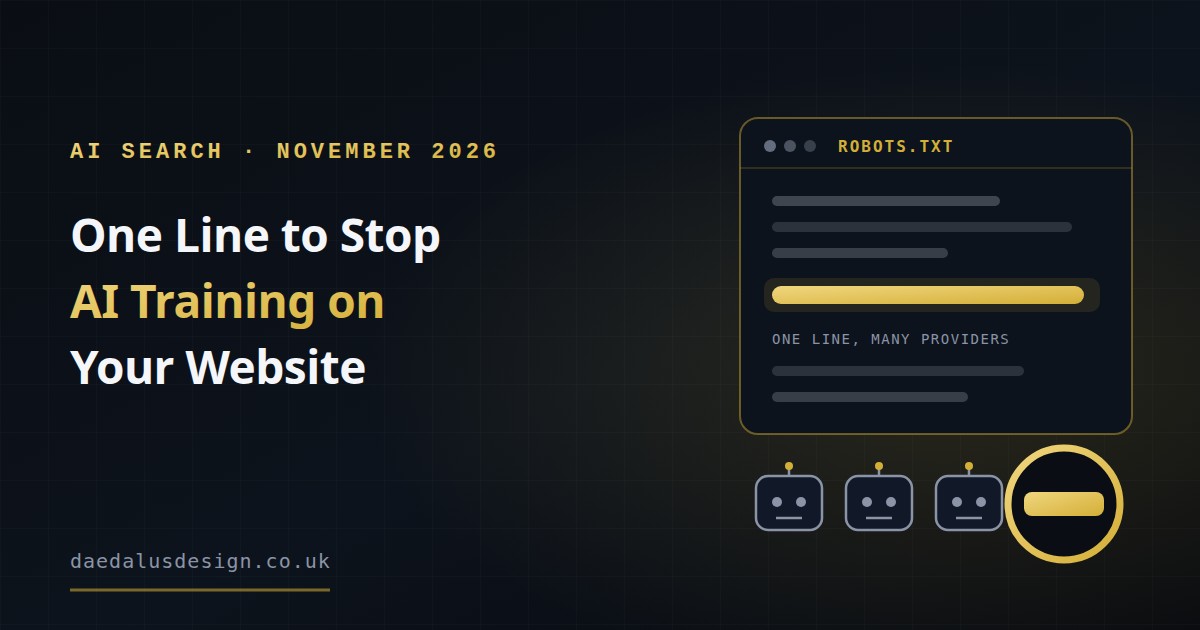
Want to stop AI training on your website? You are about to get a simple way to do it, and one decision to make alongside it.
On 30 October 2026 Google announced that it plans to support a shared AI training control in robots.txt, the small instructions file every website carries at its web address. Microsoft published its adoption the same day, and OpenAI said it would honour the same signal: one line telling many AI companies at once whether your content may be used to train their models.
It matters because opting out used to mean chasing a different crawler name for every AI company and rechecking the list each time a new one appeared. One shared instruction is the difference between a job you do once and a chore that never ends.
There is a catch worth understanding first. Keeping your content out of AI training and showing up in AI answers are separate decisions, and only one of them sends you visitors.
What was actually announced
Google's Search Central post of 30 October 2026 says the company aims to support the new control "along with other AI providers in 2027". That is a published plan with a target year, not a switch you can flip today.
The mechanics, in plain terms. Your website already carries a file that automated visitors read before doing anything, for example daedalusdesign.co.uk/robots.txt. Google's plan adds one line to it expressing your preference about AI training, which participating AI companies have agreed to read the same way. Opt out with it, and if you have said nothing about Google's own AI crawler, Google plans to treat that as if you had blocked that crawler too. Company-by-company settings keep working alongside it, so one broad preference can still be overruled for a single company.
The work sits with the AI Preferences group at the Internet Engineering Task Force, the body that writes the internet's rulebook. The document itself is an individual draft dated 30 October 2026 that expires on 3 May 2027, not a finished standard.
Why one line beats a growing list
Google has offered its own training control, Google-Extended, since 2023, and other AI companies published separate crawler names. Every one had to be tracked, tested and remembered. Firms arrive, names change, and a list written two years ago is rarely still complete.
One standard instruction changes the shape of the job. Instead of maintaining rules for a dozen automated visitors, you state your preference once and any provider joining the agreement reads it.
Two switches, not one: "don't build your models with my content" and "do show my content when customers ask AI" are separate choices with separate consequences. The first protects your words. The second is now a way for people to find you.
What the control does not do
Google is explicit about the limits. The new token says nothing about search indexing or ranking. Google-Extended has never decided whether a page appears in Google's results or where it sits, and neither will this. Opting out of AI training will not push you down the rankings, and leaving it on will not push you up.
The flip side is just as clear. For Google, the control also covers use in Gemini's answers. Sites that allow Google-Extended stay eligible to be shown and clicked when Gemini cites its sources; sites that opt out lose that route. Microsoft spelled out the same trade: refusing grounding reduces your visibility in AI experiences without affecting ordinary search results, and neither choice guarantees inclusion, traffic or payment.
Being quoted is worth measuring
You can already see when Google's AI answers mention you: Search Console's AI report shows those appearances for any site, which turns "is this worth anything?" into a question you can answer with your own numbers. Our walkthrough of the Search Console AI report shows where to find it.
If your worry runs the other way, appearing in AI Overviews when you would rather not, that is a separate control with its own process, covered by our guide to opting out. Training is now a third, independent decision.
The dates worth putting in the diary
Google has given a year and no more: 2027. Microsoft published firmer dates alongside its announcement. A transition tool opens on 15 December 2026 for sites still using its older tags, the new preferences apply from 1 February 2027 as pages are crawled, and after 1 March 2027 those older tags are no longer read as a training or grounding preference.
Most small business sites have never touched those tags, so nothing there needs action today. One line from Microsoft's guide deserves repeating: publishing a setting is not the same as activating it, because a crawler must read the file first.
The five-minute check to do this week
1. Open the file. Type your web address followed by /robots.txt into a browser. On most small business sites it is a handful of lines, sometimes only one.
2. Read what is there. Look for anything aimed at AI companies by name. If you find nothing, you have not opted out of anything, and just as importantly you have not blocked anything either.
3. Check the search crawler is still welcome. The one genuine risk here is tidying up AI instructions and accidentally disallowing the visitor that lists you in search.
The one line that really hurts: blocking the search crawler removes your pages from Google completely. Your choice about AI training has no such effect on search. If you are not certain what a line does, leave it alone and ask someone who is.
4. Put a name against the file. Note who owns it and when it was last reviewed, then diary a revisit for when Google switches its support on, planned for 2027, and before 1 March 2027 if you use Microsoft's older tags.
5. Change nothing today. The control is not live and no search engine is asking you to act. Reading it now means the decision is yours when it becomes real, rather than whatever the file says by default.
Who owns your instructions file?
All of this assumes somebody knows where your robots.txt sits, what is in it and when it was last looked at. On plenty of small business websites the answer is nobody, which works until a change like this arrives and someone has to decide what it means for you. If you would rather hand it to people who deal with this daily, our AI-powered hosting keeps the technical side owned and watched, so changes like this are decided on rather than stumbled into.
Want AI systems to name your business?
Our AEO Setup works out what you want AI systems to do with your content, then puts the facts, answers and structure in place so yours is the site they quote.
Explore AEO Setup